
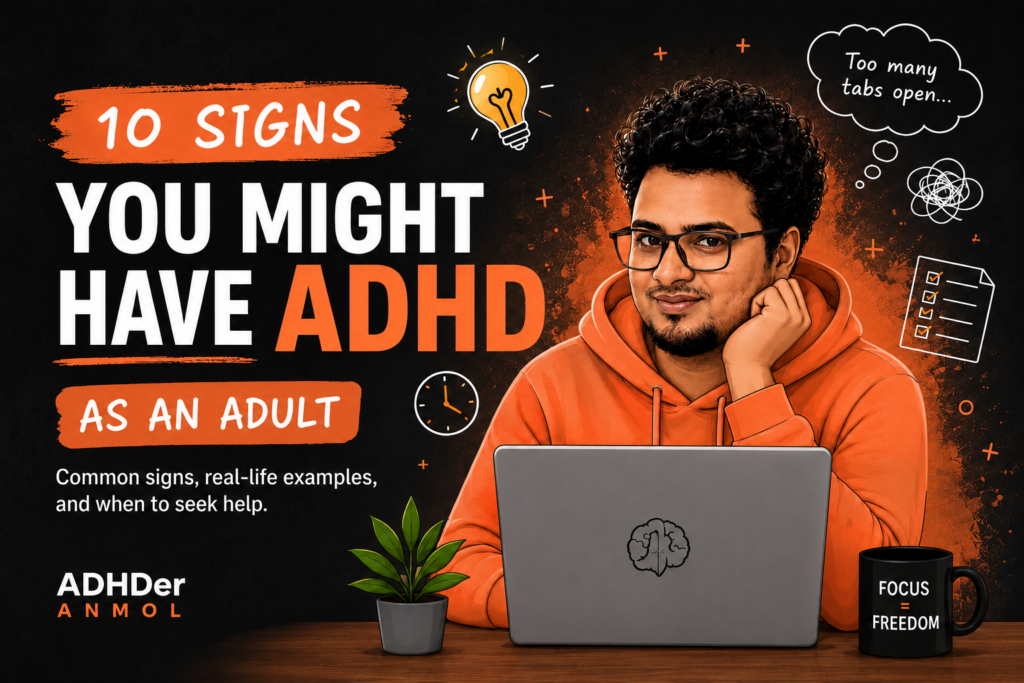
Have you ever wondered why you can focus on things you love for hours but struggle to reply to a simple email? Or why you constantly misplace your keys, forget appointments, or feel like your brain is running 100 miles per hour?
For many adults, these experiences can be part of everyday life. In some cases, they may also be signs of ADHD.
I wasn’t diagnosed until adulthood, and looking back, many things finally made sense. This article isn’t meant to diagnose you, but it can help you recognize patterns that are worth discussing with a qualified healthcare professional.
Let’s dive in.
What is ADHD?
ADHD (Attention-Deficit/Hyperactivity Disorder) is a neurodevelopmental condition that affects attention, executive functioning, impulse control, and emotional regulation.
It’s not about being lazy or lacking intelligence. Many people with ADHD are creative, curious, and capable—they simply process information and manage tasks differently.
1. You Constantly Start Things but Rarely Finish Them
You begin reading a book.
Then you switch to YouTube.
Then you decide to reorganize your desk.
Then you remember an email.
By the end of the day, you’ve been busy—but nothing feels finished.
This difficulty with completing tasks is a common challenge related to executive functioning.
2. Your Brain Never Seems to Slow Down
Your thoughts jump from one topic to another.
You’re thinking about tomorrow’s meeting, tonight’s dinner, a childhood memory, and a random business idea—all within a few minutes.
Many adults describe this as having “too many tabs open.”
3. You Forget Everyday Things
You might:
- Forget appointments
- Lose your phone or wallet
- Walk into a room and forget why
- Miss deadlines
- Leave tasks half done
Occasional forgetfulness is normal. When it happens consistently and disrupts daily life, it’s worth paying attention.
4. You Procrastinate Even on Important Tasks
You know the task is important.
You want to do it.
But somehow, your brain refuses to start.
This isn’t always laziness. For many people with ADHD, getting started can be one of the hardest parts.
5. You Hyperfocus on Things You Love
ADHD doesn’t always mean not paying attention.
Sometimes it means paying attention so intensely that you lose track of time.
You may:
- Forget meals
- Ignore messages
- Stay awake late
- Become completely immersed in a hobby or project
Hyperfocus can be a strength—but it can also make it difficult to switch tasks.
6. Small Distractions Completely Derail You
You sit down to work.
A notification appears.
Someone walks by.
You remember something unrelated.
An hour later, you’ve barely started.
External and internal distractions can make sustained focus difficult.
7. You Feel Emotionally Overwhelmed Quickly
Many adults with ADHD experience intense emotions.
You may:
- Become frustrated easily
- Feel rejection deeply
- Overthink conversations
- Struggle to calm down after stressful events
Emotional regulation challenges are common but often overlooked.
8. You’re Always Running Late
You genuinely intended to leave on time.
Then you:
- Lost your keys
- Started another task
- Misjudged how long getting ready would take
Time blindness—a difficulty sensing the passage of time—is common in ADHD.
9. You Interrupt People Without Meaning To
Sometimes your thoughts arrive so quickly that waiting feels impossible.
You may:
- Finish people’s sentences
- Blurt out ideas
- Change topics unexpectedly
This usually isn’t about being rude—it’s often about impulse control.
10. You’ve Always Felt Different
Many adults say they spent years wondering:
- Why can’t I stay organized?
- Why do simple tasks feel so difficult?
- Why does everyone else seem to have life figured out?
Receiving an ADHD diagnosis doesn’t define you—but it can provide a helpful explanation and open the door to support.
Does Having These Signs Mean You Have ADHD?
Not necessarily.
Everyone experiences some of these behaviors from time to time.
ADHD is diagnosed based on a pattern of symptoms that:
- Have usually been present since childhood
- Affect multiple areas of life (work, home, relationships, etc.)
- Cause meaningful difficulties
- Are evaluated by a qualified healthcare professional
If these signs strongly resonate with you, consider speaking with a psychologist or psychiatrist who assesses ADHD.
Remember This
ADHD isn’t a character flaw.
You’re not lazy.
You’re not broken.
Your brain may simply work differently.
With the right understanding, tools, routines, and support, many adults with ADHD learn to thrive.
Final Thoughts
If you related to several of these signs, know that you’re not alone.
This blog is based on common ADHD experiences and current understanding of the condition, but it isn’t a substitute for professional diagnosis or medical advice.
At ADHDer Anmol, I’ll continue sharing practical tips, personal experiences, and tools that have helped me navigate life with ADHD.