
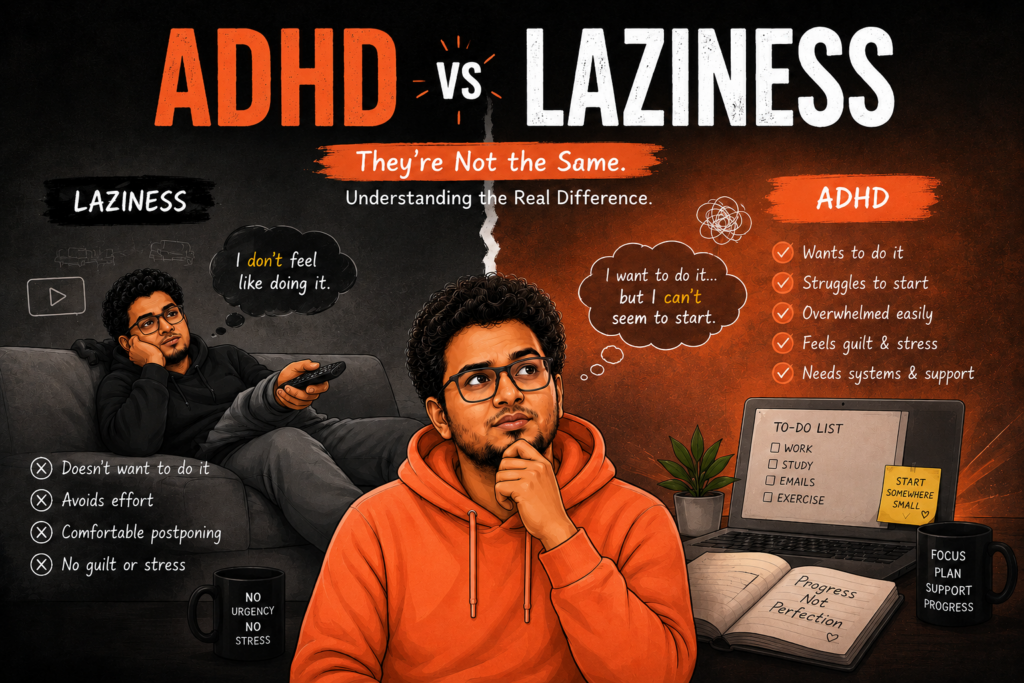
“If you wanted to do it, you would.”
If you have ADHD, you’ve probably heard this more times than you can count.
People often assume that struggling to start tasks, missing deadlines, or forgetting responsibilities means you’re lazy.
But here’s the truth:
ADHD and laziness are not the same thing.
As someone diagnosed with ADHD, I spent years believing I was simply lazy. The reality was much more complicated.
Let’s break down the difference.
What Is Laziness?
Laziness generally means choosing not to put in effort, even when you’re capable and have no significant barriers preventing you from doing the task.
A lazy person usually:
- Doesn’t want to do the task.
- Doesn’t mind avoiding it.
- Feels little motivation to change.
- Is comfortable postponing responsibilities.
Laziness is a behavior—not a medical condition.
What Is ADHD?
ADHD (Attention-Deficit/Hyperactivity Disorder) is a neurodevelopmental condition that affects executive functions such as:
- Planning
- Prioritizing
- Starting tasks
- Sustaining attention
- Managing time
- Working memory
- Impulse control
People with ADHD often want to complete important tasks but struggle with the brain processes needed to begin and stay engaged.
The Biggest Difference
Lazy Person
“I don’t feel like doing it.”
Person with ADHD
“I desperately want to do it… but I can’t seem to start.”
That difference is huge.
7 Signs It Might Be ADHD Instead of Laziness
1. You Feel Guilty All the Time
You know the work needs to be done.
Instead of relaxing, you’re constantly thinking about it.
The guilt never leaves.
2. You Wait Until the Last Minute
You’ve had two weeks.
But somehow your brain only kicks into gear the night before.
Stress becomes your motivation.
3. You Hyperfocus on Things You Enjoy
You can spend six hours editing a video…
But replying to one email feels impossible.
That’s not laziness.
That’s how ADHD attention often works.
4. Simple Tasks Feel Huge
Laundry.
Replying to a message.
Booking an appointment.
Tasks that seem easy for others can feel mentally exhausting.
5. You Keep Promising Yourself Tomorrow
Every night:
Tomorrow I’ll start.
Tomorrow comes…
Nothing happens.
Not because you don’t care.
Because starting feels incredibly difficult.
6. You Forget Things Constantly
- Keys
- Wallet
- Deadlines
- Birthdays
- Meetings
Forgetfulness isn’t carelessness.
It can be related to working memory challenges.
7. You’re Harder on Yourself Than Anyone Else
People think you don’t care.
But inside you’re thinking:
Why can’t I just do this?
That self-criticism is something many adults with ADHD experience.
Why ADHD Makes Starting Tasks So Hard
One of the biggest challenges in ADHD is task initiation.
Your brain may struggle to activate for tasks that feel:
- Boring
- Repetitive
- Unclear
- Overwhelming
- Not immediately rewarding
This doesn’t mean you’re incapable.
It means your brain may need different strategies to get started.
ADHD Isn’t an Excuse
Having ADHD doesn’t mean responsibilities disappear.
Bills still need paying.
Work still needs to get done.
The goal isn’t to avoid accountability—it’s to understand the barriers and build systems that help you succeed.
What Helps?
Here are a few strategies many people with ADHD find useful:
The 5-Minute Rule
Tell yourself you’ll work for just five minutes.
Starting is often the hardest part.
Break Tasks Into Tiny Steps
Instead of:
Clean the room
Try:
- Pick up clothes
- Make the bed
- Throw away trash
- Vacuum
Small wins build momentum.
Use Visual Reminders
Sticky notes.
Calendars.
Phone reminders.
Whiteboards.
External reminders can reduce the load on working memory.
Reduce Distractions
Turn off notifications.
Put your phone away.
Create a workspace with fewer interruptions.
Be Kinder to Yourself
You’re more likely to make progress with encouragement than with constant self-criticism.
When Should You Seek Help?
If these struggles have been present for a long time and regularly affect your work, relationships, studies, or daily life, consider speaking with a qualified psychologist or psychiatrist who can assess ADHD.
Only a trained professional can diagnose ADHD.
Final Thoughts
For years, I believed I was lazy.
What I actually needed was understanding, better tools, and the right support.
If you’ve been carrying that same label, remember this:
Needing a different approach doesn’t mean you’re lazy.
Understanding how your brain works is often the first step toward building systems that work for you.