
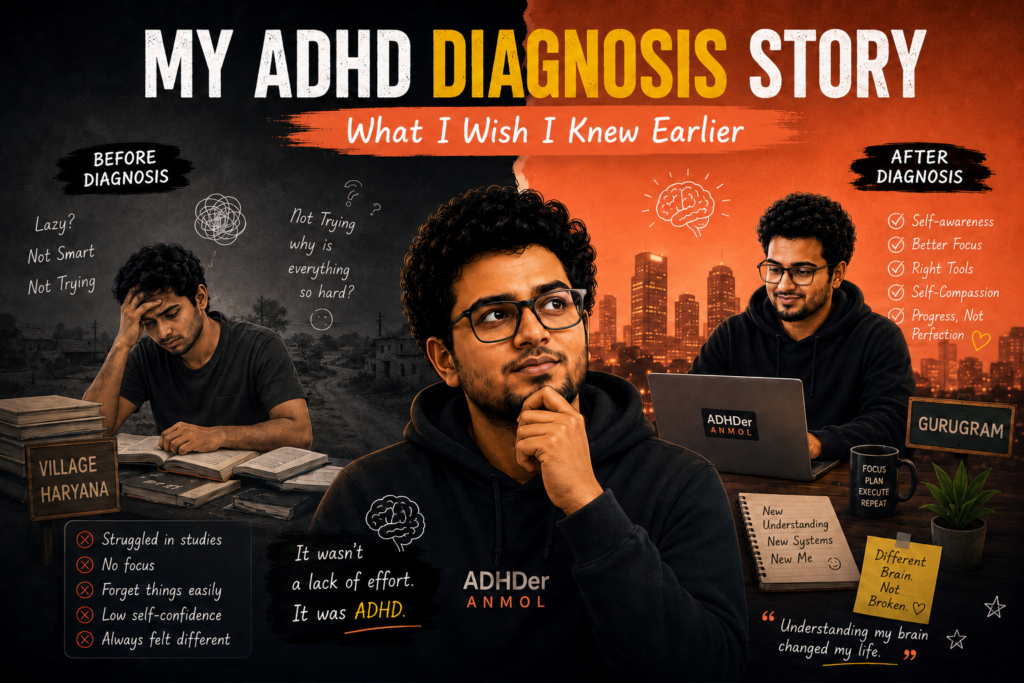
“Why am I trying so hard, yet everything feels harder for me than it does for everyone else?”
That question stayed with me for years.
For most of my life, I thought I was lazy, careless, or simply not good enough.
It wasn’t until adulthood that I discovered there was another explanation.
This is my story.
Growing Up Without Answers
I grew up in a small village in Haryana.
Back then, ADHD wasn’t something people talked about.
If a child struggled in school, people usually assumed they weren’t studying enough or weren’t serious about their future.
I struggled to concentrate in class.
I would forget what I had just learned.
Even when I genuinely wanted to study, my mind would wander.
Homework that should have taken an hour often took an entire evening.
At the time, I didn’t know there was a reason behind it.
I just thought something was wrong with me.
Living With Labels
As I got older, I started hearing words that many people with ADHD know all too well.
“You’re lazy.”
“You never pay attention.”
“You have so much potential, but you don’t use it.”
After hearing those comments enough times, I started believing them.
Instead of asking why I struggled, I blamed myself.
That self-doubt stayed with me for years.
Moving to Gurugram Changed My Life
Everything changed when I moved to Gurugram with my cousin brother in search of better opportunities.
Leaving my village wasn’t easy, but it opened doors I never imagined.
I got my first job in the hospitality industry.
It taught me discipline, responsibility, and confidence.
But even at work, I noticed something familiar.
Simple tasks sometimes felt overwhelming.
I forgot small details.
I struggled with organization.
I often wondered why things that looked easy for others felt so difficult for me.
A Conversation That Changed Everything
After years of confusion, I decided to speak with a mental health professional.
I wasn’t looking for a label.
I was looking for answers.
During the assessment, we talked about my childhood, school experiences, work, and daily life.
For the first time, someone wasn’t judging me.
They were trying to understand me.
Eventually, I was diagnosed with ADHD.
The Moment Everything Made Sense
I’ll never forget how I felt after hearing the diagnosis.
It wasn’t sadness.
It wasn’t relief alone.
It was clarity.
Suddenly, so many moments from my childhood and adulthood started making sense.
Why studying was difficult.
Why I procrastinated even when I cared.
Why I could spend hours hyperfocused on something I loved but struggled with routine tasks.
Why my brain always felt busy.
The diagnosis didn’t change who I was.
It changed how I understood myself.
What I Wish I Knew Earlier
1. I Was Never Lazy
For years, I believed my struggles were a character flaw.
Today I know they were challenges related to how my brain works—not a lack of effort.
2. Asking for Help Is a Strength
I spent too much time trying to figure everything out alone.
Talking to a professional helped me understand myself in ways I never expected.
3. ADHD Doesn’t Define Your Potential
Having ADHD doesn’t mean you can’t succeed.
It means you may need different systems, routines, and strategies.
4. Progress Is Better Than Perfection
I used to wait until everything felt perfect before taking action.
Now I celebrate small wins.
One completed task is better than ten unfinished plans.
5. Understanding Yourself Changes Everything
The biggest change wasn’t the diagnosis.
It was replacing self-criticism with self-understanding.
Instead of asking,
“What’s wrong with me?”
I started asking,
“What helps me do my best?”
That shift changed my life.
Why I Started ADHDer Anmol
After my diagnosis, I realized how many people in India are still growing up without awareness of ADHD.
Many adults are silently carrying the same labels I carried.
Lazy.
Careless.
Not trying hard enough.
I created ADHDer Anmol because I don’t want others to spend years blaming themselves like I did.
This website is where I share:
- My personal experiences
- ADHD-friendly productivity tips
- Free planners and templates
- Honest conversations about ADHD
- Resources that have genuinely helped me
I’m still learning every day.
And I want you to learn with me.
If You’re Wondering Whether You Might Have ADHD
If you’ve related to parts of my story, know this:
Reading a blog post or watching a video can’t tell you whether you have ADHD.
Only a qualified psychologist or psychiatrist can assess and diagnose ADHD.
But learning more about ADHD can be a helpful first step if you’ve been struggling for a long time.
Final Thoughts
Looking back, I don’t wish I had a different brain.
I wish I had understood it sooner.
Maybe I would have been kinder to myself.
Maybe I would have stopped comparing myself to everyone else.
Maybe I would have realized that struggling doesn’t mean you’re broken.
If my story helps even one person feel less alone, then sharing it is worth it.
Thank you for being here.
This is just the beginning of the journey.
— Anmol