
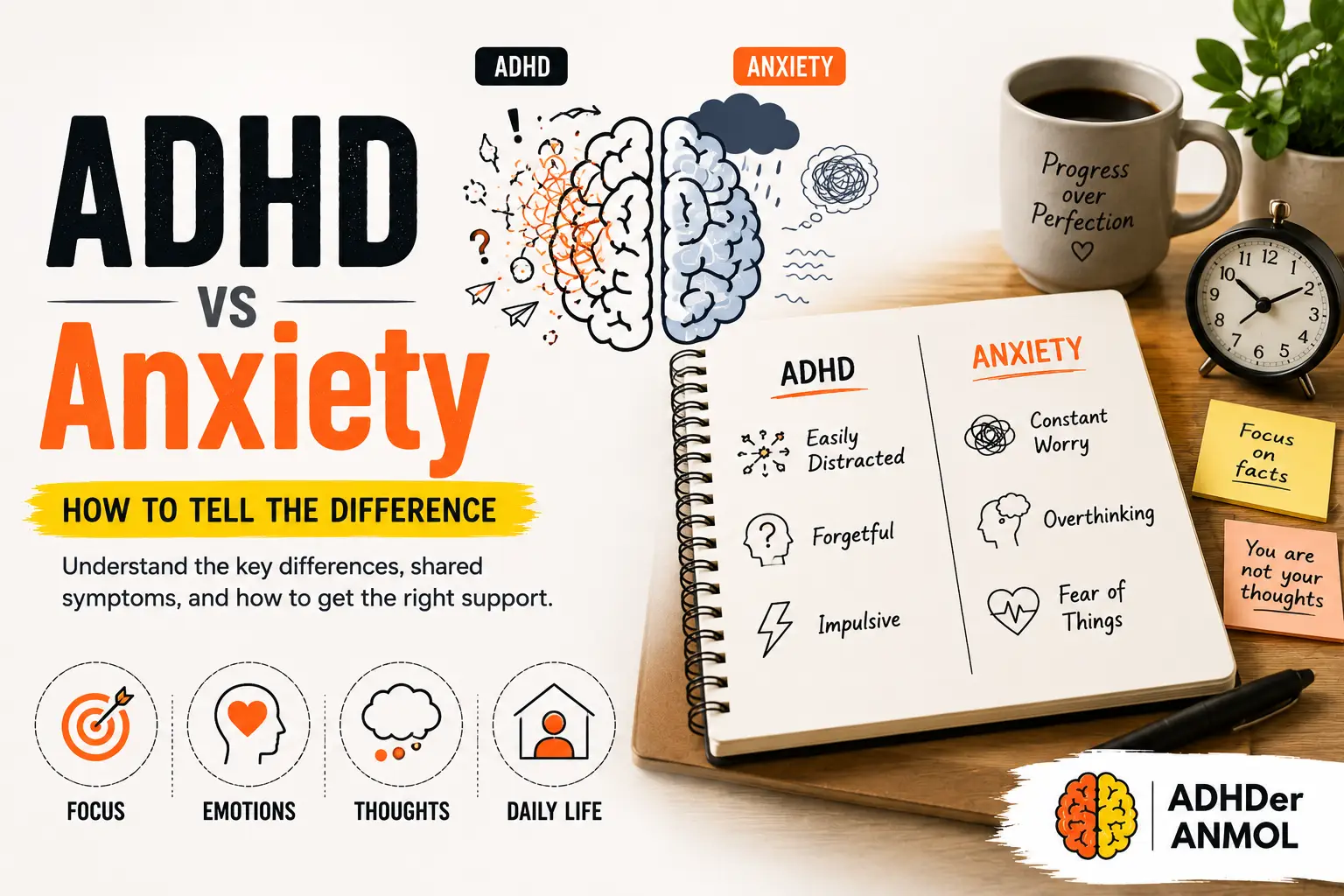
Have you ever wondered whether your racing thoughts are caused by ADHD or anxiety?
Many people confuse the two because they share several symptoms, including difficulty concentrating, restlessness, sleep problems, and feeling overwhelmed. In fact, it’s also possible to have both ADHD and an anxiety disorder at the same time.
Understanding the difference is important because each condition may require different management strategies. In this guide, we’ll explore how ADHD and anxiety differ, where they overlap, and when it’s a good idea to seek professional support.
What Is ADHD?
Attention-Deficit/Hyperactivity Disorder (ADHD) is a neurodevelopmental condition that affects executive functions—the brain’s ability to plan, organize, prioritize, regulate attention, and manage impulses.
People with ADHD often experience:
- Difficulty sustaining attention
- Forgetfulness
- Time blindness
- Procrastination
- Impulsivity
- Disorganization
- Executive dysfunction
ADHD usually begins in childhood, although many people are not diagnosed until adulthood.
What Is Anxiety?
Anxiety is a normal emotion, but anxiety disorders involve persistent and excessive worry that interferes with daily life.
Someone with anxiety may experience:
- Constant worrying
- Fear of future events
- Muscle tension
- Trouble relaxing
- Panic attacks (for some people)
- Sleep difficulties
- Avoiding situations because of fear
Unlike ADHD, anxiety is primarily driven by worry and perceived threats.
ADHD vs Anxiety: Quick Comparison
ADHD | Anxiety |
Brain struggles to regulate attention | Brain stays focused on worry or fear |
Easily distracted by everything | Focus gets stuck on anxious thoughts |
Often forgets tasks | Remembers tasks but worries excessively about them |
Starts many projects | Avoids tasks due to fear of failure |
Restlessness from under-stimulation | Restlessness from nervousness |
Impulsive decisions | Overthinks decisions |
Similar Symptoms
Many symptoms can look almost identical.
Both ADHD and anxiety may involve:
- Difficulty concentrating
- Restlessness
- Sleep problems
- Irritability
- Feeling overwhelmed
- Trouble completing tasks
- Mental fatigue
This is why diagnosis can sometimes be challenging.
Key Difference #1: Why Can’t You Focus?
ADHD
Your attention constantly shifts.
Example:
You’re studying.
Then your phone buzzes.
You notice a bird outside.
You suddenly remember an email.
Five minutes later you’re watching YouTube.
The distraction changes frequently.
Anxiety
Your attention stays locked on one worry.
Example:
“I’m going to fail.”
“What if I embarrass myself?”
“What if something bad happens?”
The brain remains stuck on anxious thoughts.
Key Difference #2: Procrastination
ADHD Procrastination
You want to begin.
But your brain struggles to start.
Even enjoyable tasks may feel impossible to begin.
Anxiety Procrastination
You delay because you’re afraid.
Examples:
- Fear of failure
- Fear of criticism
- Fear of making mistakes
Avoidance becomes a coping mechanism.
Key Difference #3: Forgetfulness
People with ADHD often forget because of attention and working memory challenges.
For example:
- Forgetting appointments
- Losing keys
- Missing deadlines
- Forgetting conversations
With anxiety, forgetfulness is more likely to happen because the mind is occupied by worry.
Key Difference #4: Restlessness
ADHD
“I need stimulation.”
People may:
- Fidget
- Pace
- Tap their feet
- Constantly switch activities
Anxiety
“I feel unsafe.”
Restlessness comes from nervous system activation rather than boredom.
Can You Have Both?
Yes.
Research shows that many people with ADHD also experience anxiety disorders.
Sometimes:
ADHD → missed deadlines → stress → anxiety.
Other times, anxiety develops independently.
When both conditions are present, it can make daily life even more challenging, but effective support is available.
Signs You May Be Experiencing ADHD
You may relate more to ADHD if you:
- Lose things often
- Have struggled since childhood
- Forget appointments
- Jump between tasks
- Experience time blindness
- Hyperfocus on interests
- Find starting tasks difficult
Signs You May Be Experiencing Anxiety
You may relate more to anxiety if you:
- Constantly worry
- Imagine worst-case scenarios
- Avoid situations because of fear
- Experience panic symptoms
- Feel tense most of the day
- Find it hard to relax
When Should You Seek Professional Advice?
If these symptoms regularly interfere with your work, education, relationships, or daily life, consider speaking with a qualified healthcare professional.
A comprehensive assessment can help determine whether you’re experiencing ADHD, anxiety, both, or another condition.
Avoid trying to self-diagnose based solely on online information.
Practical Tips That Help Both ADHD and Anxiety
Some strategies can support people with either condition:
Create simple routines
Reducing decision fatigue can make daily life feel more manageable.
Break tasks into small steps
Large tasks often feel overwhelming.
Focus on the next small action rather than the entire project.
Exercise regularly
Physical activity may help improve focus, reduce stress, and support overall well-being.
Prioritize sleep
Poor sleep can make both ADHD and anxiety symptoms feel worse.
Practice self-compassion
You’re not lazy.
You’re not broken.
Understanding how your brain works is often the first step toward finding strategies that help.
Common Myths
Myth: ADHD is just being distracted.
Reality: ADHD affects executive functioning, motivation, emotional regulation, and time management.
Myth: Anxiety is just overthinking.
Reality: Anxiety disorders involve persistent fear or worry that can significantly impact daily life.
Myth: You can only have one.
Reality: ADHD and anxiety frequently occur together.
Frequently Asked Questions
Can ADHD be mistaken for anxiety?
Yes. Both conditions can involve poor concentration, restlessness, and feeling overwhelmed, which is why a professional assessment is important.
Can anxiety cause ADHD-like symptoms?
Anxiety can make concentration and memory more difficult, but it doesn’t cause ADHD. However, the symptoms may sometimes appear similar.
Can ADHD cause anxiety?
Yes. Repeated struggles with organization, deadlines, or daily responsibilities may contribute to anxiety for some people.
Is ADHD or anxiety more common?
Both are common conditions. They can also occur together, making diagnosis more complex.