
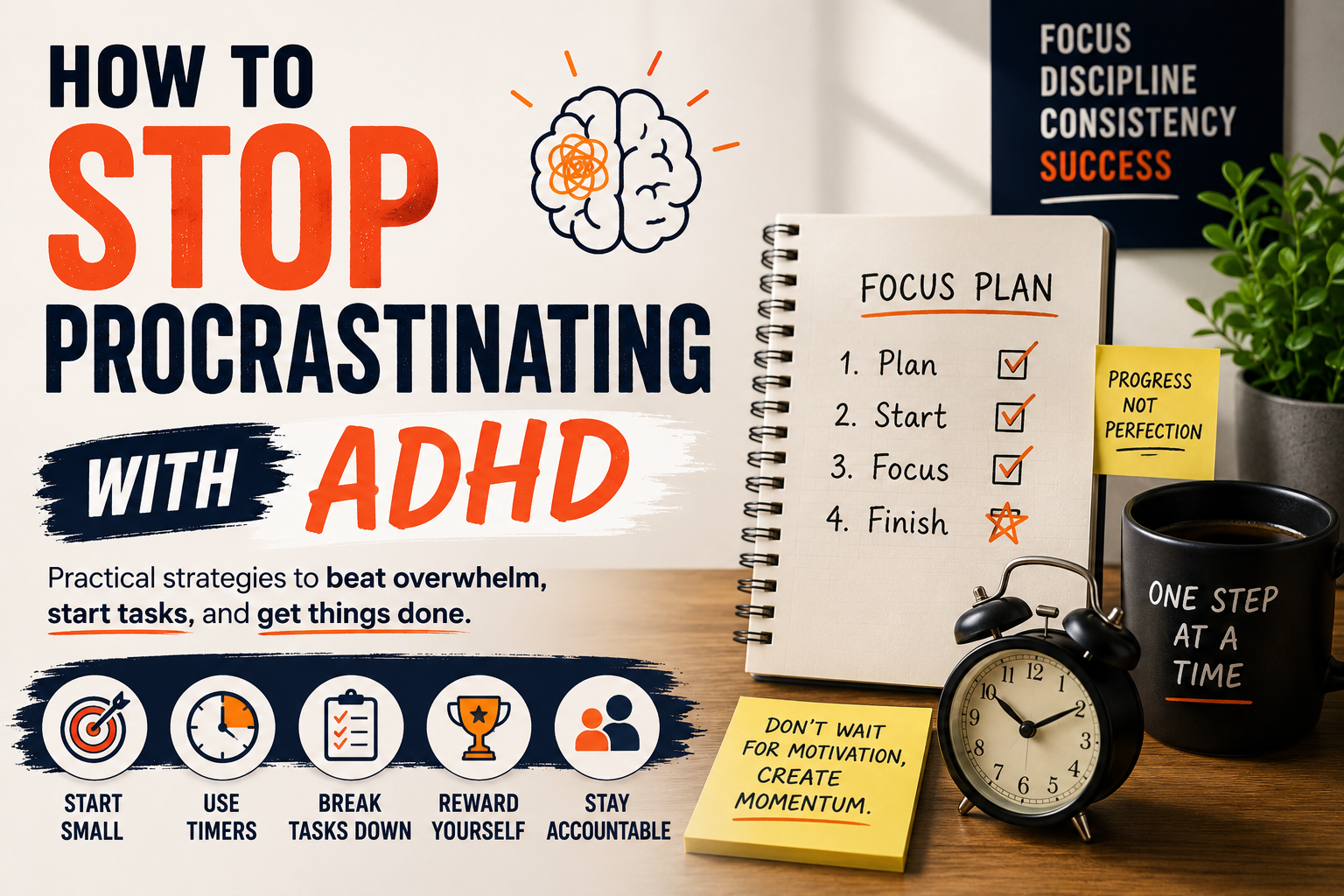
Have you ever spent hours thinking about a task instead of actually doing it?
You know it’s important.
You know it needs to be done.
Yet somehow your brain chooses to scroll Instagram, watch YouTube, clean your room, or start another project instead.
If this sounds familiar, you’re not lazy.
For many adults with ADHD, procrastination isn’t about avoiding work—it’s about struggling to get started.
I know this feeling well.
Before my ADHD diagnosis, I believed I simply lacked discipline. I would promise myself that “tomorrow” would be different. But tomorrow often looked exactly like today.
Learning about ADHD completely changed how I understood procrastination.
Why Do People with ADHD Procrastinate?
Many people think procrastination happens because someone doesn’t care.
That’s rarely true for people with ADHD.
ADHD affects the brain’s executive functions—the mental skills that help us plan, organize, prioritize, and begin tasks.
Starting can feel much harder than people realize.
It’s Not Laziness—It’s Executive Dysfunction
Imagine standing in front of a car with no key.
You want to drive.
You know where you need to go.
But you simply can’t start the engine.
That’s how many people with ADHD describe task initiation.
The desire is there.
The action feels stuck.
Common Reasons ADHD Causes Procrastination
1. The Task Feels Too Big
Your brain sees:
“Write a report.”
Instead of one task, it feels like fifty.
The result?
You avoid starting altogether.
2. Fear of Failure
Many adults with ADHD have experienced years of criticism.
Over time, you may start thinking:
“What if I fail again?”
Sometimes avoiding the task feels safer than risking disappointment.
3. Perfectionism
Ironically, perfectionism often creates procrastination.
You tell yourself:
“I’ll start when I know exactly how to do it.”
That perfect moment rarely comes.
4. Time Blindness
People with ADHD often struggle to sense time accurately.
You may think:
“I still have plenty of time.”
Suddenly it’s midnight.
The deadline is tomorrow.
5. Low Interest = Low Motivation
The ADHD brain is often driven more by interest, challenge, urgency, or novelty than by importance alone.
That’s why replying to an email can feel impossible while spending two hours researching a random topic feels effortless.
Signs Your Procrastination May Be ADHD-Related
- You wait until the last minute.
- You feel guilty but still can’t begin.
- You overthink instead of taking action.
- You frequently miss deadlines.
- You start many projects but finish few.
- You spend more time planning than doing.
- You feel mentally exhausted before you even begin.
12 Practical Ways to Stop Procrastinating with ADHD
1. Make the First Step Ridiculously Small
Instead of:
Write an article
Try:
Open Google Docs
That’s it.
Momentum starts with tiny actions.
2. Use the Five-Minute Rule
Tell yourself:
“I’ll only work for five minutes.”
Most of the time you’ll keep going.
The hardest part is starting.
3. Break Everything Down
Instead of:
Create Website
Write:
- Buy domain
- Install WordPress
- Choose theme
- Create homepage
- Write About page
Smaller tasks feel safer.
4. Set a Visible Timer
Use:
- Phone timer
- Kitchen timer
- Pomodoro app
Seeing time pass helps reduce time blindness.
5. Remove Friction
Ask:
“What makes this task difficult to start?”
Examples:
Laptop isn’t charged.
Workspace is messy.
Document isn’t open.
Phone keeps distracting you.
Solve these first.
6. Stop Waiting for Motivation
Motivation usually follows action.
Not the other way around.
Start first.
Feel motivated later.
7. Reward Yourself
After completing a task:
- Coffee
- Walk
- Music
- Favorite snack
- Five minutes on social media
Small rewards reinforce productive habits.
8. Try Body Doubling
Work alongside someone else.
They don’t have to help.
Just having another person nearby can make it easier to stay focused.
9. Plan Tomorrow Tonight
Before bed:
Write your Top 3 tasks.
Tomorrow morning you won’t waste energy deciding what to do.
10. Eliminate Decision Fatigue
Choose:
- Clothes the night before
- Breakfast in advance
- Fixed work hours
Fewer decisions leave more mental energy for important work.
11. Celebrate Progress
Many people with ADHD only notice unfinished work.
Instead ask:
“What did I accomplish today?”
Even small wins count.
12. Be Kind to Yourself
Negative self-talk doesn’t improve productivity.
Replace:
“I’m lazy.”
With:
“My brain needs a different strategy.”
Self-compassion creates space for change.
My Personal Experience
For years, I thought procrastination meant I wasn’t trying hard enough.
Growing up in a small village in Haryana, there wasn’t much awareness about ADHD. I struggled in school and often blamed myself for falling behind.
Later, after moving to Gurugram and starting my career, those same patterns followed me into adulthood.
Receiving an ADHD diagnosis helped me understand that I wasn’t lazy—I simply needed systems that worked with my brain.
Now, when I feel stuck, I don’t wait for motivation. I make the task smaller, set a timer, and focus on taking the first step. That’s often enough to build momentum.
Mistakes to Avoid
- Waiting for motivation
- Creating unrealistic schedules
- Trying to multitask
- Comparing yourself to others
- Using shame as motivation
- Expecting perfect consistency
ADHD-Friendly Daily Routine
Morning
Drink water
Review Top 3 tasks
Start with the hardest task
Afternoon
Use Pomodoro sessions
Take movement breaks
Eat lunch without rushing
Evening
Brain dump unfinished tasks
Prepare tomorrow’s priorities
Wind down for better sleep
Final Thoughts
Procrastination can make you question your abilities, but it doesn’t define you.
Learning to work with your ADHD instead of constantly fighting it can make a meaningful difference.
Every small step counts.
If today’s achievement is simply opening your laptop or writing one paragraph, that’s still progress.
At ADHDer Anmol, I believe productivity isn’t about becoming someone else—it’s about understanding your brain and building habits that help you thrive.
Related Articles
- What Is ADHD?
- Best Productivity Tips for Adults with ADHD
- ADHD vs Laziness
- Understanding Executive Dysfunction
- 10 Signs You Might Have ADHD as an Adult
- My ADHD Diagnosis Story
Disclaimer: This article is for educational purposes only and is not a substitute for professional medical advice, diagnosis, or treatment. If ADHD symptoms are significantly affecting your daily life, consult a qualified healthcare professional.