
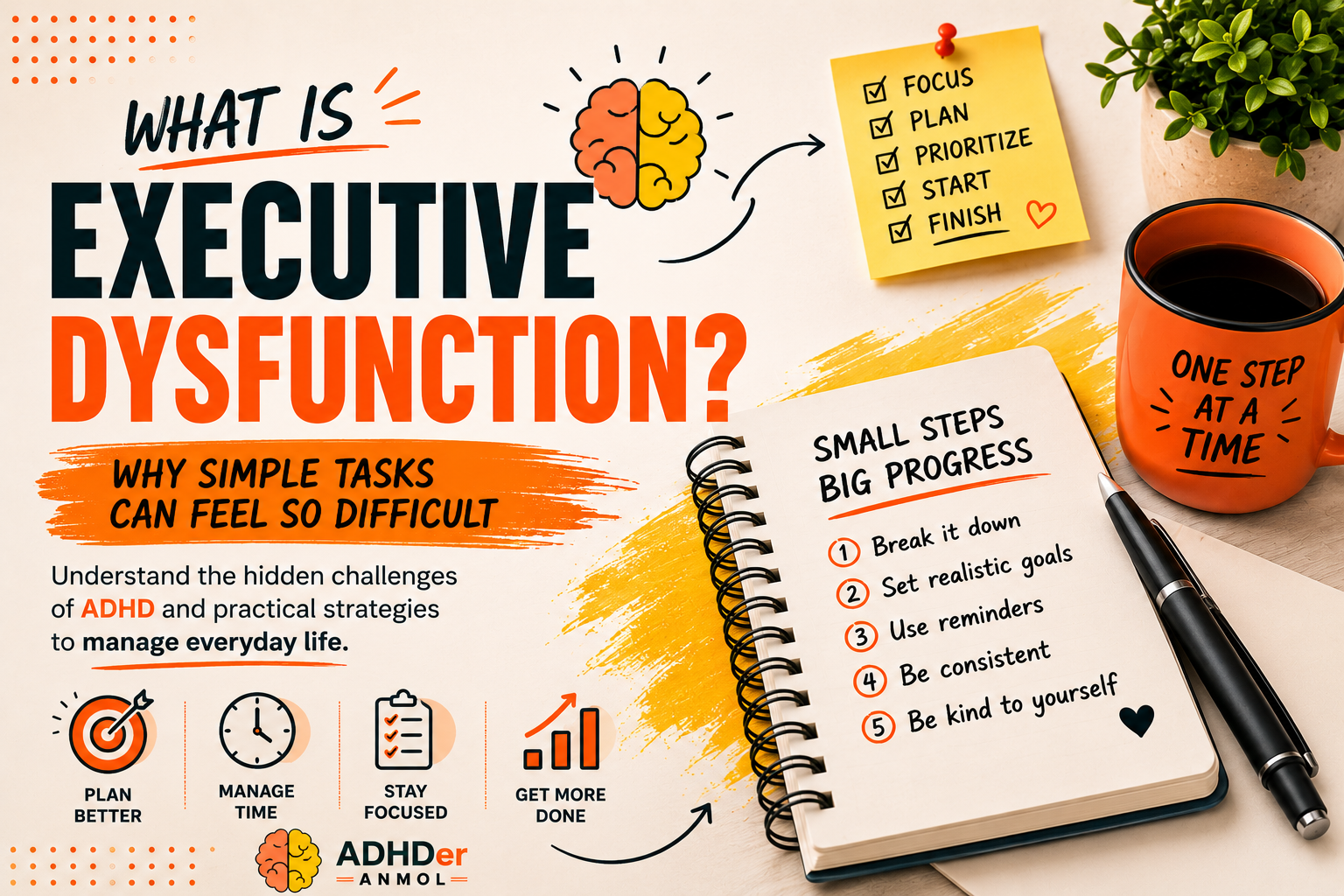
Have you ever stared at a simple task—like replying to an email, folding laundry, or paying a bill—and felt completely unable to start?
You know the task is important.
You want to do it.
Yet your brain seems to hit an invisible wall.
If you’ve experienced this, you’re not lazy or lacking motivation. You may be dealing with executive dysfunction, one of the most common challenges for people with ADHD.
Understanding executive dysfunction changed the way I viewed my own struggles. Instead of blaming myself for being “lazy” or “careless,” I realized my brain simply processes planning, organization, and task management differently.
In this article, we’ll explore what executive dysfunction is, how it affects daily life, and practical ways to manage it.
What Is Executive Dysfunction?
Executive dysfunction refers to difficulties with the brain’s executive functions—a set of mental skills that help us manage daily life.
These skills include:
Planning
Organizing
Starting tasks
Staying focused
Managing time
Remembering information
Controlling impulses
Switching between tasks
Regulating emotions
Completing projects
Think of executive functions as the brain’s management system. When that system isn’t working efficiently, everyday activities can become surprisingly difficult.
Is Executive Dysfunction the Same as ADHD?
No.
Executive dysfunction is not a diagnosis on its own.
Instead, it’s a group of challenges that can occur in several conditions, including:
ADHD
Autism Spectrum Disorder (ASD)
Depression
Anxiety disorders
Traumatic brain injury
Some neurological conditions
However, executive dysfunction is especially common in people with ADHD because ADHD directly affects the brain networks involved in executive functioning.
What Does Executive Dysfunction Feel Like?
Many people describe it like this:
“It’s not that I don’t want to do the task. It’s that my brain won’t let me start.”
You may feel:
Overwhelmed by simple tasks
Stuck even when you know what to do
Mentally exhausted before beginning
Guilty about unfinished work
Frustrated with yourself
These feelings can be confusing because other people often assume you’re procrastinating on purpose.
Common Signs of Executive Dysfunction
1. Difficulty Starting Tasks
Even easy tasks can feel impossible to begin.
Examples:
Replying to emails
Paying bills
Cleaning your room
Starting homework
Writing a report
2. Poor Time Management
Many people with ADHD experience time blindness.
You may:
Underestimate how long tasks take
Miss deadlines
Arrive late
Lose track of time while working
3. Forgetfulness
You may forget:
Appointments
Birthdays
Deadlines
Keys
Wallet
Important conversations
This doesn’t mean you don’t care—it means your working memory may be overloaded.
4. Trouble Prioritizing
When everything feels equally important, deciding what to do first becomes difficult.
Instead of starting, you may become overwhelmed and do nothing.
5. Losing Focus Easily
You begin one task…
Then remember another.
Then check your phone.
Then open YouTube.
Suddenly an hour has passed.
6. Emotional Overload
Executive dysfunction doesn’t only affect tasks.
It can also make it harder to manage emotions.
You may:
Feel overwhelmed quickly
Become frustrated easily
React impulsively
Struggle to calm down after stress
7. Difficulty Finishing Projects
Starting can be hard.
Finishing can be even harder.
Many people with ADHD have several unfinished projects because maintaining momentum becomes challenging once the excitement wears off.
How Executive Dysfunction Affects Daily Life
Executive dysfunction can impact almost every area of life.
At Work
Missing deadlines
Difficulty organizing tasks
Forgetting meetings
Procrastinating on important projects
At School
Late assignments
Difficulty studying
Poor organization
Trouble following instructions
At Home
Clutter builds up
Household chores feel overwhelming
Bills get forgotten
Laundry stays unfolded
In Relationships
Forgetting important dates
Interrupting conversations
Appearing distracted
Difficulty managing responsibilities
My Personal Experience
Looking back, many of my biggest struggles were actually signs of executive dysfunction.
Growing up in a village in Haryana, I often believed I wasn’t trying hard enough. Teachers and others sometimes interpreted my difficulties as carelessness or lack of discipline.
After moving to Gurugram and starting my career, those same patterns followed me into adulthood. Even when I genuinely wanted to complete tasks, getting started often felt much harder than it seemed for other people.
Learning about ADHD helped me understand that these weren’t personal failures—they were challenges related to how my brain manages planning, organization, and attention.
That understanding helped me replace self-criticism with practical strategies.
Practical Strategies to Manage Executive Dysfunction
1. Break Tasks into Tiny Steps
Instead of:
Clean the kitchen
Try:
- Put dishes in the sink
- Load dishwasher
- Wipe the counter
Small wins build momentum.
2. Use External Reminders
Don’t rely only on memory.
Use:
Phone reminders
Sticky notes
Calendar apps
Smart speakers
Checklists
3. Time Block Your Day
Assign specific times for tasks.
Example:
9:00–9:30 → Emails
9:30–10:30 → Writing
10:30–10:45 → Break
4. Use Visual Checklists
Seeing progress makes tasks feel more manageable.
Crossing off completed items also provides a sense of accomplishment.
5. Reduce Distractions
Before working:
Silence unnecessary notifications
Close extra browser tabs
Keep only the materials you need nearby
6. Try the “Just Five Minutes” Rule
Tell yourself:
“I’ll only do this for five minutes.”
Often, starting is the hardest part.
7. Create Consistent Routines
Routines reduce the number of decisions you have to make.
Morning routine
Work routine
Evening routine
The fewer decisions, the more mental energy you save.
8. Be Compassionate with Yourself
Executive dysfunction isn’t a character flaw.
Treat yourself with the same patience you would offer a friend facing the same challenge.
When Should You Seek Professional Help?
If executive dysfunction is significantly affecting your:
Work
Education
Relationships
Daily responsibilities
Mental well-being
consider speaking with a qualified healthcare professional.
If you suspect ADHD but have never been evaluated, an assessment may help you better understand your experiences and explore appropriate support.
Frequently Asked Questions
Is executive dysfunction only caused by ADHD?
No. It can occur with ADHD, autism, depression, anxiety, brain injuries, and other neurological conditions.
Can executive dysfunction improve?
Yes. While it may not disappear completely, many people find that strategies, routines, therapy, coaching, and, when appropriate, medication can make daily life much more manageable.
Is executive dysfunction laziness?
No.
Laziness generally means choosing not to do something.
Executive dysfunction means wanting to do something but struggling with the mental processes needed to begin, organize, or complete it.
Final Thoughts
For years, I believed that if I just tried harder, everything would become easier.
Learning about executive dysfunction helped me understand that the problem wasn’t a lack of effort—it was a lack of the right tools and strategies.
If you recognize yourself in this article, know that you’re not alone. With greater awareness, supportive habits, and the right guidance, it’s possible to build systems that help you succeed.
At ADHDer Anmol, my goal is to share practical knowledge and personal experiences so that others don’t have to spend years wondering why everyday life feels harder than it should.
Related Articles
Disclaimer: This article is for educational purposes only and should not be considered medical advice. If you believe you may have ADHD or another condition affecting executive functioning, consult a qualified healthcare professional for assessment and guidance.